 P.O. Box 40, 130 Broadway Street Holland, MB R0G 0X0



2026 General Municipal Elections
General municipal elections are held every four years on the fourth Wednesday in October. This includes elections for mayors / reeves and councilors.
Elections for school trustees take place the same day.
For general information about school board elections, please contact: Education Administration Services Branch, Manitoba Education at 204-945-6899, or the Manitoba School Boards Association at 204-233-1595 or www.mbschoolboards.ca
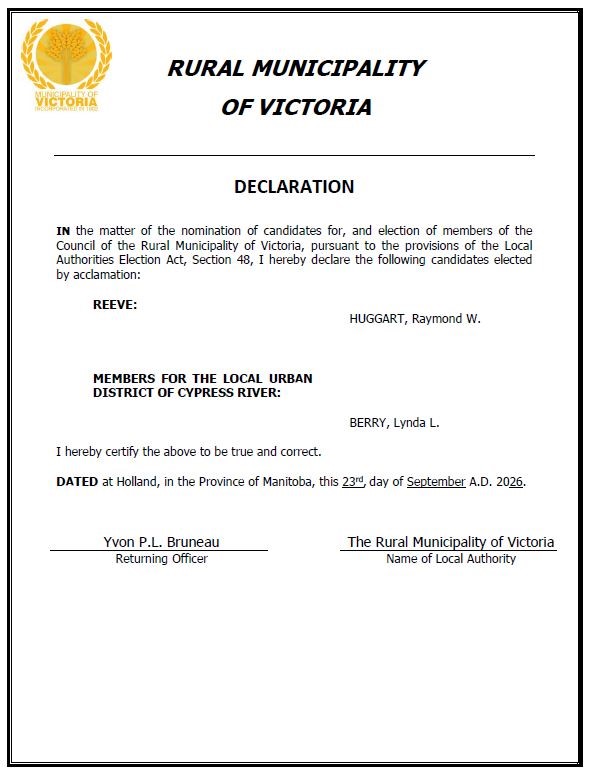
Election Notice
Registered Candidates
| Name | Position | Nomination Filing Date | Disclosed Offences [Section 42(1)] Municipal Councils & School Boards Elections Act |
Status |
| Raymond Huggart | Reeve | September 22, 2026 | Driving Under the Influence - 1981 | Acclaimed |
| Jacee Frizzley | Councillor | September 21, 2026 | None disclosed | |
| Tyler Kirbyson |
Councillor | September 22, 2026 | None disclosed | |
| Danny Carels | Councillor | September 16, 2026 | None disclosed | |
| Reginald Marginet | Councillor | September 16, 2026 | None disclosed | |
| Rick Lee | Councillor | September 17, 2026 | None disclosed | |
| Jason Dobbin | Councillor | September 21, 2026 | None disclosed | |
| Neil Leslie | Councillor | September 22, 2026 | None disclosed | |
| Frank Neilands | Holland LUD | September 16, 2026 | Driving Under the Influence - 1984 Sexual Assault - 2008 |
|
| Jacob Carels | Holland LUD | September 22, 2026 | None disclosed | |
| Matthew Tolton | Holland LUD | September 21, 2026 | None disclosed | |
| Kayla Sholdice | Holland LUD | September 22, 2026 | None disclosed | |
| Tara Hilhorst | Holland LUD | September 22, 2026 | None disclosed | |
| Lynda Berry | Cypress River LUD | September 21, 2026 | None disclosed | Acclaimed |
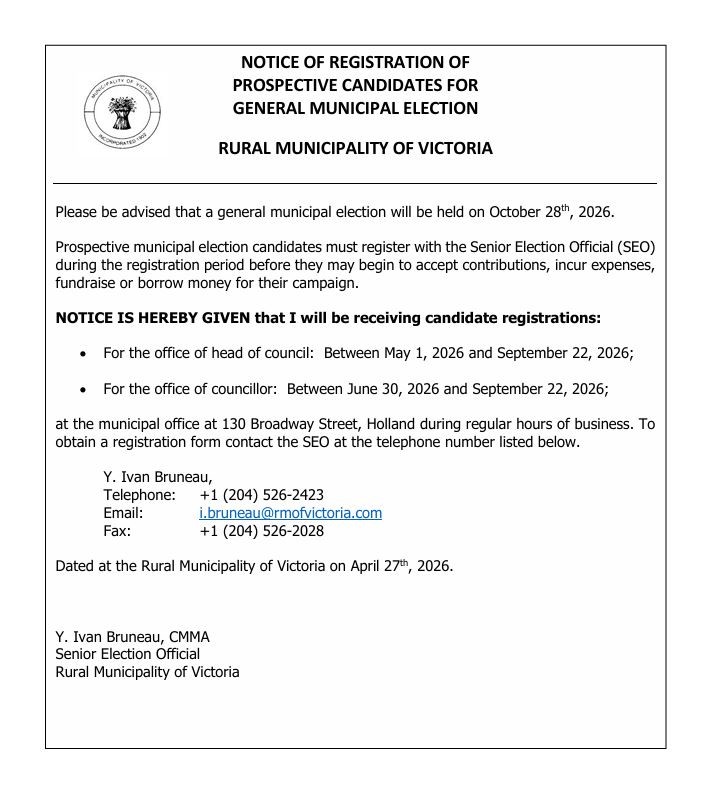
Notice of Registration
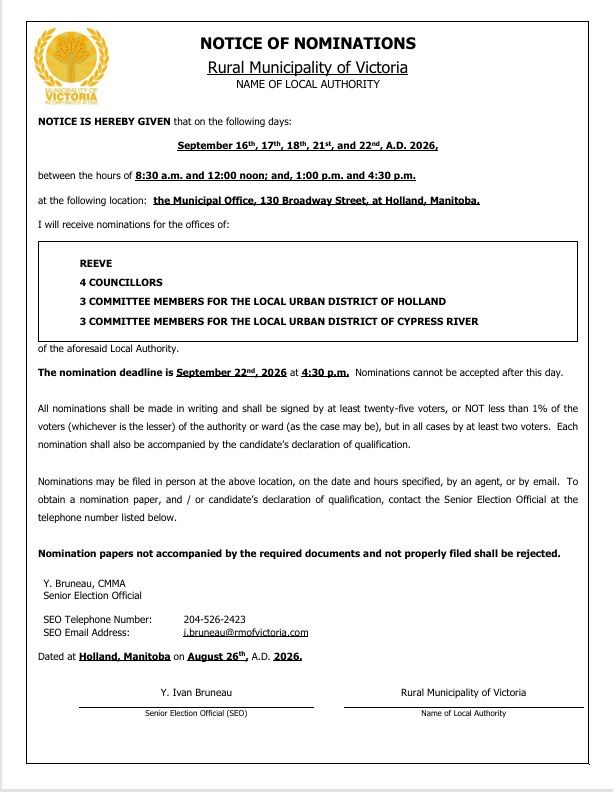
Notice of Nominations
Information for Prospective Municipal Election Candidates
A Candidate's Guidebook is available electronically at the link below.
The Guidebook provides municipal candidates with an overview of the election process, the steps to run for municipal office, and a summary of campaign finance rules.
Municipal Candidates Guidebook (English) – Municipal Elections 2026, opens PDF document
For more information on running for municipal council, contact the municipal office.
Information for Voters in Municipal Elections
Municipal elections are an opportunity for Manitobans to participate in building strong, healthy, and sustainable local governments. Make sure to vote and become involved in your community's future!
Elections Legislation
Legislation that sets out election rules, processes and procedures is available online:
The Municipal Councils and School Boards Elections Act: Sets out the process for electing members of council for all municipalities and school boards.
The Municipal Act: Sets municipal election requirements for the 136 municipalities outside of Winnipeg.
The City of Winnipeg Charter: Sets municipal election requirements for the City of Winnipeg.
The Public Schools Act: Sets requirements for the election of school trustees.
Frequently Asked Questions
Promoting Transparency in Municipal Elections:
Candidate Registration, Nomination and Public Disclosure FAQ
Originally posted by Association of Manitoba Municipalities. Click here to view original PDF.
To help ensure transparency, consistency, and public trust, this FAQ explains the difference between campaign finance registration and nomination, outlines when a person officially becomes a candidate, and clarifies when candidate information is made public. It is designed to help residents, prospective candidates, and other interested parties better understand the municipal election process. This FAQ was developed in consultation with the Province of Manitoba - Department of Municipal and Northern Relations to help ensure that the information provided is accurate, consistent, and aligned with applicable legislation and election requirements.
Registration
1. When does registration take place?
For the 2026 municipal general election, registration begins:
• May 1, 2026 for people intending to run for Head of Council; and
• June 30, 2026 for people intending to run for councillor.
Registration remains open until September 22, 2026, the close of nominations. Registration is a separate campaign-finance process and does not make a person a candidate.
2. Should registration information be available to the public when a person’s registration papers are submitted?
Yes. The Municipal Councils and School Boards Election Act states that documents or materials relating to an election in the custody of the SEO are public records and must be made available for public inspection under conditions acceptable by the SEO. Registration papers that are submitted by people are documents relating to an election in the custody of the SEO.
3. Should registration information be posted publicly when the registration papers are submitted?
As the information is publicly available, municipalities are encouraged to publicly post the names of people who have registered for ease of access. Municipalities could consider posting on their website, or posting physically at the municipal office or another location, or through other methods.
Proactive disclosure can:
• provide the public with clear information about who has registered for campaign finance purposes;
• promote transparency around campaign activities;
• allow potential donors and others to confirm that an individual has registered before participating in campaign-related activities; and
• reduce the need for members of the public to make individual information requests.
Proactive disclosure is a recommended best practice, rather than an explicit disclosure requirement under the campaign-finance provisions of The Municipal Act.
4. Can members of the public request information about who has registered?
Yes. Where registration information has not been proactively disclosed, members of the public may arrange to inspect the registration papers received by the SEO under The Municipal Councils and School Boards Elections Act. Access to registration papers could also be requested under The Municipal Act, or through the processes available under The Freedom of Information and Protection of Privacy Act (FIPPA), subject to any applicable requirements or exceptions under that legislation.
Proactively disclosing registration information may help avoid the need for individual requests and provides greater transparency about who has registered to campaign.
Nominations
5. When does nomination take place?
For the 2026 municipal general election, the nomination period is: September 16–22, 2026. Nomination is governed by sections 38 to 47 of The Municipal Councils and School Boards Elections Act (MCSBEA). Once the SEO accepts a person’s nomination papers, the person is officially a candidate and the accepted nomination papers must be available for public inspection.
6. Should information be posted when someone takes out nomination papers?
Information should not be posted when someone takes out nomination papers. A person becomes a candidate only when their nomination papers are submitted during the nomination period and accepted by the SEO.
7. Should candidate information be posted available to the public when the nomination papers are submitted?
Yes. Once the nomination papers have been accepted by the SEO, the person is a candidate and the accepted nomination papers must be available for public inspection under the Municipal Councils and School Boards Elections Act.
8. Should candidate information be posted publicly when the nomination papers are submitted?
Yes. Once the nomination papers have been accepted by the SEO, the person is a candidate and the accepted nomination papers must be available for public inspection under the Municipal Councils and School Boards Elections Act. As the information is publicly available, municipalities should post the names of candidates publicly for ease of access. Additionally, the SEO is required by The Municipal Councils and School Boards Elections Act to publish the candidates’ names and their disclosures of any offences from their nomination papers on the municipal website. This includes any cases where no offences were disclosed.
9. Can nomination papers be submitted before the official nomination period of September 16–22?
No.
10. Can an individual begin campaigning before their nomination has been officially accepted by the SEO during the September 16–22 nomination period?
For the 2026 municipal general election, the campaign period begins:
• May 1, 2026 for people intending to run for Head of Council; and
• June 30, 2026 for people intending to run for councillor.
However, candidates cannot accept donations or spend money on their campaigns until they have registered.